

ZONTA GUIDING PRINCIPLES
In addition to the objectives concerning women’s rights agreed upon when the organisation was founded, Zonta’s activities are guided by the UN Declaration of Human Rights and the UN Convention on the Elimination of All Forms of Discrimination against Women (CEDAW). The countries that have signed the Convention are committed to prohibiting all forms of discrimination against women and to reporting on their country-specific actions to the Commission at regular intervals.
In accordance with the UN Declaration of Human Rights, a human rights convention was drawn up in Europe in 1950. The European Social Charter was completed in 1961. It came into force in 1965, and Finland signed the agreement in 1991. The Social Charter focuses on rights relating to working life and social rights. Each country has its own corresponding objectives.


CEDAW
Convention on the Elimination of All Forms of Discrimination against Women (CEDAW)
The Convention on the Elimination of All Forms of Discrimination against Women (CEDAW) aims to promote the equal realisation of human rights for women. The Convention contains provisions on, among other things, citizenship, education, participation in working life, health care and women’s economic rights.
Observations made by the CEDAW Committee regarding Finland
• Accumulation of parental leave for women
• Gender segregation in working life
• Insufficient number of women’s shelters and lack of regional coverage
• Poverty among ageing women and working single parents
• Lack of a comprehensive strategy and action programme to promote equality
ISTANBUL CONVENTION
The Council of Europe Convention on preventing and combating violence against women and domestic violence was opened for signature in Istanbul on 11 May 2011. Finland was one of the signatory states. The Convention entered into force internationally on 1 August 2014 and in Finland on 1 August 2015.
The Istanbul Convention is the first European human rights convention concerning women.
Its purpose is to
- prevent and eliminate violence against women
- protect victims of violence, and
- bringing perpetrators of violence to justice.
In addition, the Convention aims to promote the elimination of all forms of discrimination against women and the achievement of substantive equality between women and men.
Achieving the objectives of the Convention requires comprehensive, holistic and coordinated cross-administrative action programmes. In addition, the Convention establishes a specific monitoring system.
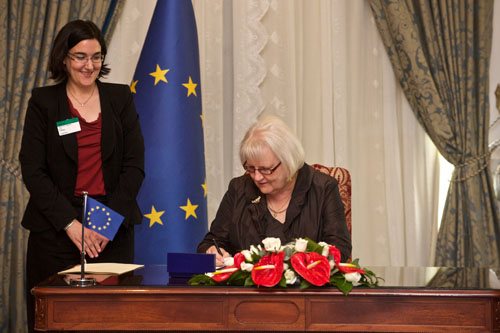
The agreement was signed by Ambassador Irma Ertman in Istanbul on 11 May 2011.